


While they are in the Arctic, the whales typically feed for four to six months, Stewart said. Then, for the next six to eight months, they largely fast. That means the Arctic feeding grounds are their most important source of food.
Why food is less available in the region is complex, and scientists are still untangling it. What they know, according to Stewart, is that the system used to work like this: Algae would grow on the bottom of sea ice, then fall to the seafloor as the sea ice melted. The algae would dissolve and fertilize a productive seafloor, feeding amphipods in the sediment. Whales would suck up the dirt and find the nutritious critters inside.
Now, researchers think sea ice is melting earlier in the year, allowing sunlight to reach the water column earlier. That promotes the growth of phytoplankton and other species, which take in some of the nutrients that used to reach the seafloor. Scientists think that is reducing the overall amount of prey available to the whales.
For gray whales, the cost of a bad summer is often paid the following spring, when the trip north costs them more energy than they were able to accumulate through feeding the year before.
“Right now, as they migrate north, is when they’re skinniest. It’s the longest since they’ve last eaten, and it’s when they’re the most sensitive and most vulnerable to dying from starvation,” Stewart said.
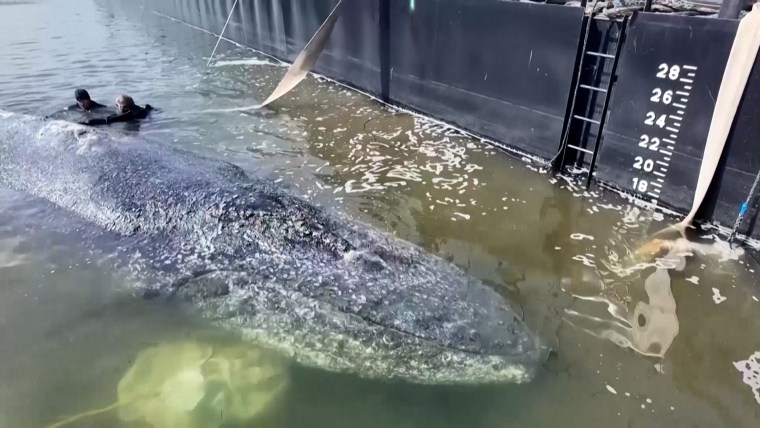
Calambokidis said some whales have turned up in odd places this season, including one that swam up the Willapa River in Washington and died, possibly searching for sustenance to finish its journey.
“As these animals become malnourished, they become more desperate, and I also think they become debilitated and less aware of their surroundings and they lose their navigational sense,” he said.
NOAA’s latest estimates suggest the gray whale population has fallen from 27,430 whales a decade ago to 12,950 last summer, though Stewart cautioned that the modeling is not precise and is likely to overstate the decline.
Not all Pacific gray whales are so reliant on the Arctic, however. A small population of about a dozen whales, sometimes called Sounders, detours from the typical migration route to eat ghost shrimp in northern Puget Sound, north of Seattle, and then farther north to the Bering and Chukchi seas. Another subset, called the Pacific Feeding Group, has more than 200 whales and spends summers in coastal waters off Northern California, Oregon, Washington and southern Canada. The relatively small groups have been resilient to the broader pattern of decline.

“It gives us some indication that there may be other foraging strategies other gray whales will be able to take up to weather environmental storms long term,” said Elliott Hazen, a research ecologist at NOAA’s Southwest Fisheries Science Center.
In the 19th and early 20th centuries, eastern North Pacific gray whale populations were devastated by commercial whaling. Stewart said populations most likely dropped to as low as about 1,000 or even a few hundred. But after restrictions on whaling were implemented and the animals became protected under the Marine Mammal Protection Act, gray whales were one of the whale species fastest to rebound. The species was removed from the endangered list in 1994.
Stewart said that he doesn’t fear the whales are at risk of extinction but that progress is being undone.
“We’re significantly lower in abundance than when the species was delisted from the Endangered Species Act, so we are in uncharted territory from a recovery perspective,” he said.